
The growth Britain wants needs water Britain doesn't have
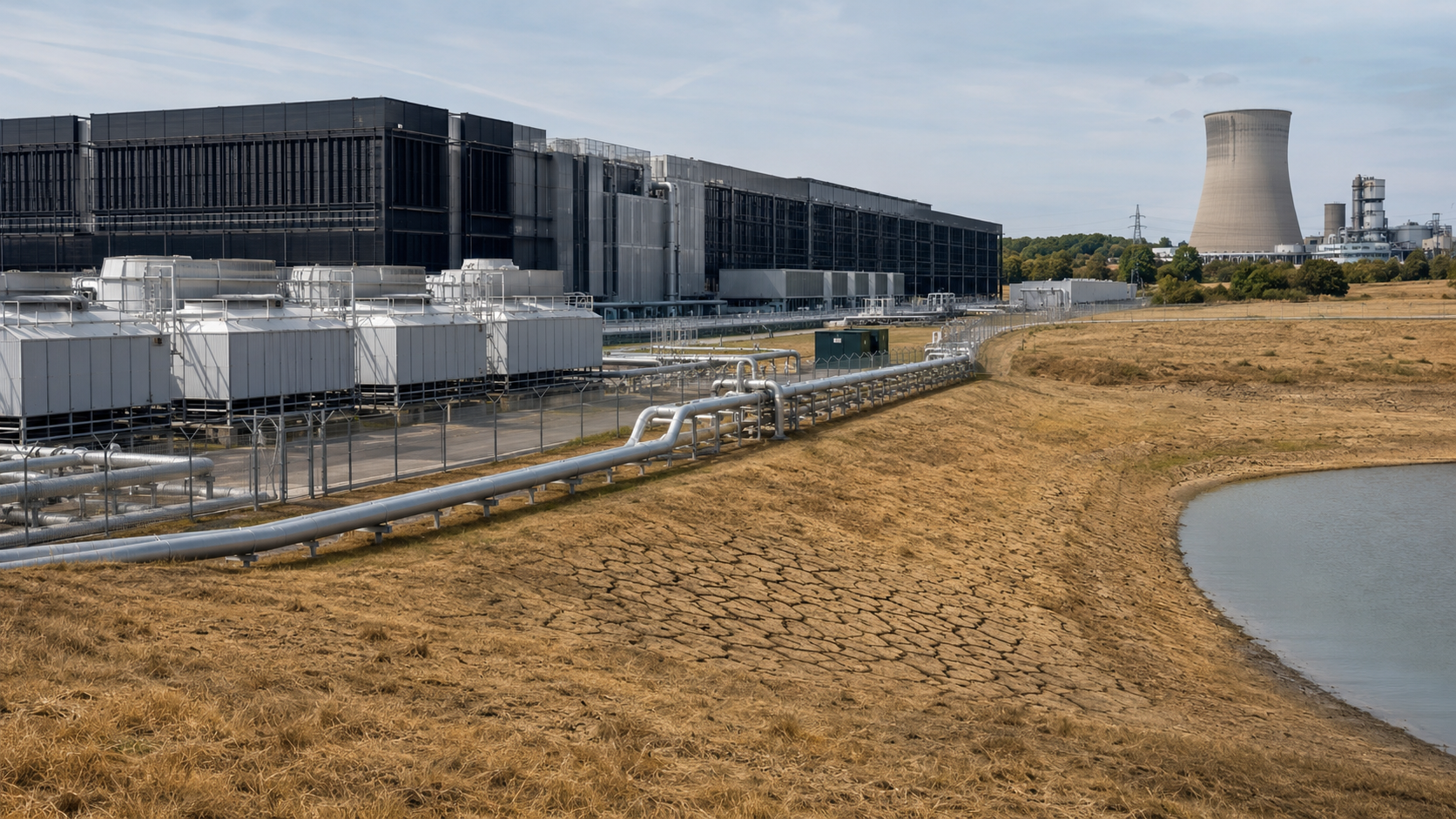

The government wants 1.5 million new homes built this parliament. It also wants UK data centre capacity to triple by 2030, powering the AI ambitions ministers talk about constantly. Both are framed as essential to drive growth, attract investment and make the UK more competitive. However, both pledges landed amid widespread drought declarations and hosepipe bans covering millions of customers. Why that matters is obvious, even to the casual reader.
Homes need water. Data centres need even more. The concern is that government may not have accurately calculated how much.
The housing that nobody budgeted for
Independent analysis commissioned by Water UK doesn’t paint an optimistic picture. Their figures suggest that England currently has enough spare water capacity to support around 420,000 of the 1.5 million homes the government has pledged, leaving more than a million planned homes without a confirmed water supply. As they point out, there’s not much room to manoeuvre: in some parts of the UK, the buffer between total available water and water already being used is as low as 2%.
Water companies are already having to push back on the government's ambitious housebuilding targets, where they don’t line up with the reality on the ground. South East Water has told Tonbridge and Malling Borough Council that it can supply only 6,300 of the 19,700 homes required in its local plan by 2042 — a shortfall of more than 13,000 homes in one Kent borough alone. And in Cambridgeshire, chalk streams are already being artificially topped up by the Environment Agency because of over-extraction, even as ministers propose a development corporation to unlock another 150,000 homes in the area.
The Guardian’s environment correspondent Sandra Laville reported on this recently, highlighting the impasse that local authorities find themselves in when housebuilding targets conflict with droughts and hosepipe bans. Quoted in the article’s title, Paul Harvey, the independent leader of Basingstoke and Deane council, points out the issue succinctly: “we cannot magic up more water.”
But under AMP8, there is funding available – £108bn already earmarked for water infrastructure investment through to 2030. So the question isn't just "is there a problem?", it’s whether the money committed is being directed as needed to solve it.
The data centres that government ignored
The other growth area that requires a significant share of the water supply is the much-talked-about construction of data centres. In this case, it seems that rather than a planning oversight, the issue is a failure to consider demand in the first place. Water UK told MPs in a written briefing to the Environmental Audit Committee that the government's water forecasts are flawed because they leave data centres out of the demand modelling altogether.
The numbers are modest now, but the projected growth is a different story. Current use by data centres in England is around 6.6 million litres of drinking water per day. If data centre capacity triples as planned, then by the end of the decade, Water UK estimates this figure will reach almost 20 million litres. That’s the equivalent of the daily water usage of 60,000 homes, and of course stacks on top of whatever housing growth also goes ahead.
To further complicate things, domestic and data centre usage may not be judged equally, as the government has designated data centres as critical national infrastructure. That makes sense on the face of it: this is infrastructure that underpins crucial services. But when it comes to shortages, does that mean that data centres take priority over domestic supply? It’s a question that hasn’t been publicly addressed.
Two headlines: one underlying story
Beyond the specifics, the housing and data centres issues are essentially the same story told twice. Neither one is really related to how dry this summer has been; the weather just makes the story more newsworthy. The root causes go back further: demand was planned based on assumptions that turned out to be optimistic, while the supply-side infrastructure needed to close the gap has lagged for years.
That’s important in framing the discussion we should be having. If we don’t have enough water to supply planned development (whether that’s housing, data centres, or the next national priority), then the instinctive response is either “create more capacity” or “lower the targets”. But before doing that, there’s a subtler question to ask: how did the gap between planned demand and actual capacity arise in the first place?
To put it another way, how confidently does anyone actually know where the water headroom exists, region by region, before a housing target is set or a data centre planning application is approved? Right now it seems that the honest answer, at least for large parts of the country, is “not very”.
Water resource plans are revised periodically, often lag behind updated housing figures by several years, and were never designed with hyperscale data centre demand in mind. On the other hand, there’s evidence that projected figures for data centre usage may err on the “worst case” side. Analysis by Computer Weekly points out that not all data centres use the most water-intensive cooling methods available; in fact, many UK schemes are moving towards closed-loop interior cooling and “dry” systems for exchange to the environment.
How do we close the information gap?
Inevitably, supply will have to be increased. We need new reservoirs, improved treatment infrastructure and fewer leaks. The industry is already making that case. But increasing the available supply doesn't solve a problem that is, at its core, an information and coordination issue.
Before a local authority commits to a housing number, or a data centre operator commits to a site, the underlying question is the same one that runs through most of the water industry's current challenges: does anyone have an accurate, current picture of what the network can actually support? Not a five-year-old water resource plan built on assumptions about falling consumption. An up-to-date model of existing capacity, existing constraints, and existing demand already competing for the same water.
How do we get there? With the same digital engineering techniques already in use under AMP8 to understand the country’s ageing infrastructure. That means laser scanning and drone photography to create accurate digital twins of water networks and resource zones. Planners can then simulate if a proposed development – whether that’s a housing estate or a data centre – can be sustainably supplied before shovels are in the ground. It also means better information management and data exchange between stakeholder organisations so that planning can be based on realistic water usage figures, not incomplete estimates.
None of that makes the underlying scarcity disappear. Most probably, Britain needs better water infrastructure and needs it faster than it’s currently being built. But at least the conversation would be grounded in an accurate picture of supply and demand, with growth targets and investment set accordingly.


